Subliminal: How Your Unconscious Mind Rules Your Behavior, By Leonard Mlodinow

RATING

2 stars

N/A = good but not on the scale

1 star = perspective supplementing

2 stars = perspective influencing

3 stars = perspective altering

SHORT SUMMARY (272 words or less)

My biggest takeaway from this book:  the existence of a subconscious mind is not theory, it is a proven fact.  And so is its influence on conscious thinking.


There’s this concept in Hinduism of the “lotus dream”–that our world isn’t really the true world, that it’s the result of a divine dream on a cosmic time scale.  This book doesn’t get into that at all, but it does discuss the idea that our conscious understanding of the world is a mere model, processed by inputs in our conscious mind and broad influences observed by our subconscious.  In a mind blowing example, our brain gets hit with the equivalent of 11 million bits of information every second, and our conscious mind processes only 16 to 50 bits of that.  The rest is filtered, categorized, and discarded by our subconscious.

There are a few areas that I want to explore further.  One:  the actual neuroscience and biology of the human brain.  Which regions do what?  How do they interact?  Two:  the impact of categorization.  How does the subconscious automatically categorizes sensory information and how is our conscious mind subsequently influenced?  Three:  the remnant artifact of the subconscious mind.  Forgotten experiences do not always disappear; they remain in your cognition long after you forget them.  Book example:  lullabies sung to babies.  You don’t remember them when you grow older, but the emotional impact remains in your subconscious long after your conscious mind forgets the melody.  And four:  the evolutionary conditions that lead to the biological change in human cognition.  Specifically, what happened 50,000 years ago when our brain chemistry changed so suddenly?

LONG SUMMARY:

Started 10/21/2017:

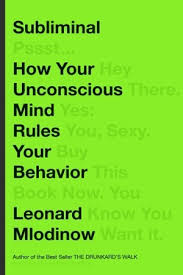
-Wow, you can judge a book by its cover.  Because the cover of this book is cool.  See image above.

-The introduction to the book states the underlying premise.  The subliminal mind or subconscious mind is an actual thing.  It’s not something of theory.  It has been proven to exist.  And it affects behavior of the conscious mind.

-Fun fact:  neuro-scientists estimate that 11 million bits of sensory information are sent to the brain every second.  But the conscious mind is able to process only 16 to 50 bits of sensory information per second.

-1/3 of the brain’s cerebral processing is dedicated to visual perception.  Visual processing occurs on two levels–the conscious and unconscious level.

-The book discusses the concept of “blindsight”:  where people who are visually blind (i.e., their conscious mind cannot perceive vision) can never the less process visual information in their unconscious mind.

The book talks about two experiments to explain this.  The first experiment was with a patient who had damage to the portions of the left and right side of the brain responsible for processing vision.  They took this guy down a hall filled with obstacles, and though he couldn’t see any of them, he was able to avoid all of them.  When asked how, he couldn’t explain.  Likewise, there is a story about a soldier who had his optical senses damaged by a bullet during war.  Though he cannot see, he can still perceive motion when it occurs.  The Wikipedia summary of the concept of blindsight describes it as people responding to visual stimuli that they cannot see.

This is an interesting concept, a theme that I imagine will repeat itself throughout the book.  The perceived world is a model constructed by our brain from the combination of conscious processing and unconscious processing.  As I was listening to this, it made me realize that in some ways, the world we perceive is an illusion or an approximation by our brain of the world that actually exists.  And thus, we live in not just one world, but every person sees a different worldly illusion based on their sensory perceptions, conscious and unconscious processing.  Kind of trippy to think about.  It reminds me of concepts in Vedanta Yoga of the conscious and unconscious mind and perception.  I’ll have to find a way to write about linking these concepts.

-A long discussion about memory recall.  It’s well known that human memory recall works in the following way:  people can remember the thematic and broad details of an event; people almost always fill in the smaller details, often times making them up; people are convinced that these smaller details are real memories.

-Studies show that in police line-ups, between 20 to 25% of the time, a wrong person is identified.  Author says that this is an interesting fact — 1 out of 4 or 5 times you’re going to pick the wrong person, and the police often know it because the “wrong” person identified is planted by them.  But when someone identifies someone thought to be a suspect, then that evidence is taken as almost iron-clad evidence.

-Human conscious memory is easily tricked into believing memories that are made up. Author says that this gives him a measure of humility. Memories may not always be how you remember.

-Conscious memory recall fades as you age. Author says that it seems as if humans evolved with their conscious memory not not retain it all but rather as a survival mechanism to prioritize what to remember and how to fill the gaps.

-Another interesting point, though your conscious memory fades with time your unconscious still holds on to emotional artifacts. So while you may slowly forget memories of loved ones, their inconscious effect is still with you.

-Discussion of neofrontal cortex and it’s correlation to group size.  Author says that you can look at the neofrontal cortex of primates and correlate the size of groups that they associate with.  For humans, this is about 150 people.

-Author makes an interesting point about human evolution.  That our brain chemistry and structure actually changed about 50,000 years ago even though we’ve been evolving as species in the “homo” genus for 2 million years and that homo sapiens have been around for 200,000 years.

-Theory of mind:  the ability that humans have to understand the cognitive thinking, motivations, emotional responses of other humans.  This is hugely powerful, as it enables us to build vast networks and organizations beyond our 150 neofrontal cortex limit.

-Three levels of human brain:  reptilian brain, limbic system, neocortex

Reptilian brain controls base survival responses, including fear, hunger, fight or flight response.

Limbic system controls emotion, behavior, motivation and long term memory.

Neocortex:  governs complex social interactions, language, advanced planning.  Our neocortex has grown.

-I kind of zoned in and out to the end, but there was a good discussion on the notion of cognitive categorization.  The idea is that the ability to categorize things certainly aided in our survival as a species.  But it also negative effects for modern social interactions.  As an example, if someone asked you to state what you thought the temperature difference would be on June 30 when compared to June 1, your answer would probably different significantly compared to a time frame defined from June 15 to July 15.  Even though the time segment is the same, the fact that we have mentally categorized it in a certain way lends us to think differently about the results.

The big take away is that (1) our subconscious inertia is to put most of our experiences (including people) into categories; (2) that elements within one category are viewed to be very similar, and differences in entries between categories are viewed to be very different; (3) subconscious and conscious cultural cues can influence how we categorize traits per category (or how we even define categories themselves); and (4) actual, experiential interactions can break down preconceived or subconscious characteristics based on categorizing.

So in a real world example, it’s easy to lump people into categories by race, to group members of one race as very similar and people in different races as different, that cultural cues can influence how we define those categories and characteristics, and personal interactions with people can change the rules and associations we have with categories.

It’s important to note that the categorization happens on a subconscious level mostly.  So while your conscious mind may think that you do not hold any categorization bias, it is important to understand that your subconscious mind does, and the awareness of that can insulate your conscious mind from being unknowingly influenced by your subconscious category break downs.
Planet Money Podcast – “Nudge, Nudge, Nobel”

11/2/2017

Episode was about the origin of behavioral economics. Summed up succinctly by the creator of the field (Richard Thaler), who won a Nobel Prize: traditional economics can be boiled down to two words “people optimize.” Thaler’s response that summarizes behavioral economics: “no they don’t”

The idea is that people do not act rationally in line with traditional economic expectations. Example, take months to save money but when tax refund comes in people view it as free money and spend it irrationally.

Behavioral economics gave rise to this notion of “Nudge units”—that if you set up systems by default, people tend to stay in. For example, many companies set up Nudge units for 401k contributions. That is, when you start a job, you’re automatically set up to contribute a certain salary percentage to your 401k amount vs not having the default and having people actively sign up. When these default Nudge units are set up, people stay in them.

So on a micro scale, set up your own Nudge units to optimize returns on time and money.

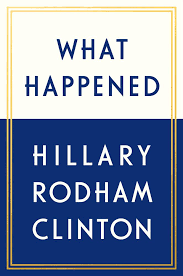
What Happened, Hillary Rodham Clinton

RATING

1 star

N/A = good but not on the scale

1 star = perspective supplementing

2 stars = perspective influencing

3 stars = perspective altering

LONG SUMMARY AND SHORT SUMMARY (272 words or less)

I started out reading this book with the expectation to summarize it like the others. And though the book was interesting, to me, from a historical perspective, I felt exhausted to try to write about it. Probably because of the recency of the election, even putting my politics aside.

So here are my big takeaways.

One, history will look at this election as a very bizarre one.  The monumental upset and the historical candidacies, not just gender but age and tradition, would be enough to make it something history will dissect for a generation. Add the very basic intrigue of the loser having to attend, on stage, the election of the winner. What a bizarre time.

Two, regardless of your politics, it really is amazing that Hilary Clinton never was elected to the office. If you were with her, you look to the many things that coalesced to provide the upset, and it seems unreal. And even if you were not with her you come to the same conclusion with your political views in stride, that it was a big surprise to see Trump win the election.

Three, Clinton won 3M more votes than Trump. That’s a big number. The question that remains: is Clinton’s loss a repudiation of the Democratic Party platform? Or does the focus need to be on the 80,000 that swayed the election? In other words, does the Democratic Party pivot towards economic populism only and move away from equal rights issues, or can they be competitive doing both moving forward?

William Henry Harrison, by Gail Collins

RATING

N/A

N/A = good but not on the scale

1 star = perspective supplementing

2 stars = perspective influencing

3 stars = perspective altering

Short summary:  (272 words or less)

What did you do over the last month?  Well, whatever it was, it’s probably more than what William Henry Harrison did during his 31 days as President.  In fact, the ultimate irony of this summary is that it took me over six months to read a biography of a President who served for only one.

It’s an unfortunate fate, to be remembered as the most inconsequential US President.  But that’s the hand that Harrison was dealt.  His biggest accomplishment as President was that he was the first to die office.  His funeral set some unfortunate future traditions, the most evocative and eerie being the riderless horse that echoed across time, 122 years later for President Kennedy.

Harrison’s life, though, did have an impact on American history, in the same magnitude as many non-Presidents whose biographies often go unexamined:  Aaron Burr, George Mason, Elbridge Gerry, Hamilton, Clay, Calhoun, etc.  So, it was interesting enough to read about Old Tippacanoe.  But make no mistake, I’m in the midst of a boring stretch.

Harrison’s main contribution came in two ways:  defeating of the powerful Shawnee Chief Tecumseh; and much later in life, his first-of-a-kind folky campaign for President in 1840.  The impact of Tecumseh’s defeat cannot be overstated.  It crushed any hope for the formation of a Native Federation to counterbalance and counterattack American expansion.  The impact of Harrison’s 1840 Log Cabin Campaign cannot be over-exaggerated.  It set the tone for a litany of Presidential candidates’ narratives of the “common man” and running against an ambiguous Washington elite.

Also, the word “booze” became mainstream after the 1840 campaign.  Perfect, because booze is what you’ll need to get through this summary.

Expanded summary
I’m not going to lie, this was a pretty uninspiring biography.  Not because of the author, but because I just couldn’t get into reading about Harrison’s life.  But just like in every great novel, there are the exciting sentences that convey action or emotion or crescendo a plot line, and then there are the boring transition sentences that do the mundane work of opening doors and moving characters across town.  If the story of US Presidencies was a novel, Harrison’s presidency would be the equivalent of a brief sentence about the main character brushing their teeth in the morning.  The deflating thing, too, is that there are some later presidents that are considered to be worse than William Henry Harrison, at least according to organizations filled with nerds who create historical rankings of Presidents.  So, great, I get to look forward to that!

This is also the hardest summary to write about.  For some reason, it’s more difficult to succinctly summarize what he did, mainly because I’m struggling to find a broader theme to write on.  With Jackson, it was populism.  With Van Buren, it was inadequacy.  With William Henry Harrison, it’s more like a WTF summary:  how to retrospectively justify reading this biography and to find some thematic meaning out of it.

Which is a little harsh and a lot unfortunate.  Because Harrison did actually accomplish a fair amount in his life.  I guess when you consider it all, Harrison’s life theme to me might be: “steward of the new West.”

He moved to Kentucky when he was young, and through his political career expanded his role to develop and integrate the western territories into the federal consciousness.  Through the Harrison Act, he expanded the pool of people who could purchase land tracts from the federal government, and I’d venture a guess that a fair amount of present day wealth can be tracked back to that.

As governor of the Indiana Territory for 12 years, he battled and defeated Chief Tecumseh and Tecumseh’s brother, Prophet.  British and Indian forces were growing nervous of US expansion and had joined forces in the War of 1812.  Harrison had once said that, absent American ambitions to expand westward, Tecumseh would have a vast empire to rival contemporary Mexico or Peru.  Harrison’s defeat of Tecumseh was a major victory.  Tecumseh was ultimately killed and with his death died too the hope for a unified Native American opposition to US expansion into the present day midwest.

On the issue of slavery, Harrison expanded the legality of slavery in the western territory, even though Congress had outlawed it.  Basically, Harrison’s viewpoint was that a slavery ban tempered growth in the area and spooked wealthy Virginia aristocrats from settling there.  One can only wonder what tone this may or may not have set as westward expansion continued.  I’m interested in trying to connect those dots as I read later about the Missouri Compromise and “bloody Kansas.”  Harrison himself was a slave owner.  Harrison later declared himself against slavery but voted with the south on the expansion of slavery.

He pretty much hung out for a while after that, served in Congress and in JQA’s administration.  He moved back home (Ohio) and didn’t do much while Jackson became President.  He ran for President in 1836, and though he lost, he carried a few states.  Harrison was nominated by the Whig Party (and backed by a young Abe Lincoln) in the 1840 election, which, to me at least, seems to be the first true “change” election as we would recognize today.  The Panic of 1837 ensured that the Whigs were going to win, it was just a matter of who.

And in that economic climate, with a bizarre caricature of then President Martin Van Buren in the public mind, came Harrison’s lasting legacy.  The Log Cabin Campaign of 1840.  This was the first campaign in which a presidential candidate personally campaigned for the office. The Whigs were able to message and create a brand for Harrison as a the Log Cabin, Hard Cider candidate. They turned the log cabin and hard cider imagery into metaphors for frontier ruggedness.  The irony of it all was that Harrison grew up on a sprawling plantation with tutors to provide his education, Van Buren was the son of a tavern keeper who grew up speaking Dutch and had no former education and was completely self taught.  The slogan to remember:  “Tippecanoe and Tyler too.”

Harrison won that election, of course, but in the end, he didn’t wear a coat to his inauguration and then gave a long-ass speech when it was rainy and freezing as hell outside, and so he caught a cold and died 31 days later.  It’s all good though, because William Henry Harrison’s grandson, Benjamin, would grow up to become President himself.

And that’s all I have to say about that.

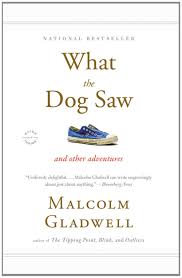
What The Dog Saw, By Malcom Gladwell

RATING

1 star

N/A = good but not on the scale

1 star = perspective supplementing

2 stars = perspective influencing

3 stars = perspective altering

LONG SUMMARY & SHORT SUMMARY

Note:  No short summary since I didn’t finish the book.  It was interesting enough, but I started losing interest about 1/3 of the way in.

Started June 19, 2017:

I actually read this book a few years ago, but I decided to give it another listen, and it’s not very long.  The reason I reopened this book is because I remember reading the story about the dog whisperer, and I forgot how Gladwell describes his abilities to handle tough dogs.  My parents have these two Jack Russell/Chiwawa mix dogs, and though they are good to them, they are extremely territorial and protective.  I’m naturally scared of dogs, so when I go there to visit, we have to keep the dogs away.  It made me wonder about the namesake dog story in this book, so I figured I’d revisit the whole thing.

This book is a series of short stories by Gladwell composed from his writing at The New Yorker.  Like most Gladwell pieces, the storytelling is captivating.  I also find that given how he threads the stories together, there can be a potential to confuse correlation with causation, and his simplicity in story telling might sometimes oversimplify incredibly complex issues.  So grain of salt.

Here, I won’t summarize each short story, but will rather pull thigns that I find to be interesting or memorable.

Short story #1:  The Pitchman

-This one is about Ron Popeil and his ability to sell infomercial product, including the Veg-o-Matic.  A lot about Popeil’s sale style here, but one memorable statement was how a true seller sees a group of 25 people and tries to sell to 20 of them and keep the remaining 5 people around as the seed for the next presentation they are going to give.  Interesting thought.

Short story #2:  The Ketchup Conundrum

-This story is about Heniz Ketchup’s ability to dominate the Ketchup market and how competitor products haven’t taken that dominance away.  Analogies made to French’s vs. Grey Poupon Dijon, and also entries of multiple pasta sauce competitors.  The story describes this guy, Howard Muskovitz, who came up with this taste differentiation theory.  That for a lot of foods, people prefer a spectrum of preferences.  Mustard, pasta sauce, etc.  But ketchup for some reason is different.  Once you create a spectrum of ketchup choices, those other choices are seen as sauces instead of condiments for most consumers.  Gladwell also talks about the harmony of the five tastes: sweet, sour, bitter, salt, umami, and how Heinz unifies the tastes.  Other products do this, mainly Coke and Pepsi.  If you compare store brand ketchup or cola, you can detect the five (or less) tastes individually, like specific notes spiking on a musical instrument.  When you have a harmonious product, it blends together like a symphony.

Short story #3:  Blowing Up

This one is about Nassim Taleb, of Black Swan fame.  It’s a description of Taleb’s option investing strategy.  Making small bets on fat tail options that have a relatively low likelihood of “winning.”  The idea is that Taleb buys calls and puts at low-probability, low-cost events.  On most days, Taleb’s fund loses money, but when a Black Swan event (an event unforeseen and unpredictable that disrupts a rational market) happens, Taleb’s fund wins big.  He’s made a fortune in the post-9/11 crash and in the 2008 financial crisis.  Gladwell compares him to traditional option sellers, who make a fortune when markets act predictably but lose it all when there’s a Black Swan event.

Radiolab – “Time”

This episode was a rebroadcast from a very early one in the series.  It’s called “time.”  The podcast describes how “railroad time” fundamentally shaped a town in Ohio.


Back in the late 1800s, people kept time on a personal level.  That is, everyone had their own personal pocket watch, maybe a clock at home or at their place of work or business.  If someone’s clock said 2:30 and someone else’s clock said 2:35, it didn’t really matter that much.  This all changed when the railroad came in.  The railroad imposed a strict and universal time system on the town in order to run a train schedule.  So if you’re trying to catch a 12pm train, but your clock is five minutes fast, that’s a problem.   The advent of the railroad imposed the need for uniformity of people’s clocks and watches.


An interesting story from this is how the Railroad actually changed the time of “noon” in this town from the time approximating the moment at which the sun was directly overhead to a moment about twenty minutes after that.  They effectively “moved” time.

Thinking, Fast and Slow by Daniel Kahneman

RATING

N/A

N/A = good but not on the scale

1 star = perspective supplementing

2 stars = perspective influencing

3 stars = perspective altering

SHORT SUMMARY (272 words or less)

The book received high praise (author is a Nobel Prize winner in economics) as a detailed analysis of the duality of human thought and how it affects perception, decision making and conclusive analysis.  I am sure the praise was warranted, but I just couldn’t get into it.  Maybe it should be a night stand book for me to pick up every now and then.  I may try again later, but after dedicating five hours of listening with fifteen more to go I’d rather move on.  But here are my takeaways.

The basic theme:  our process of thinking is governed together by a “fast thinking” system and a “slow thinking” system.  The fast thinking system primes responses for the slow/deliberate thinking system.  In one example, people primed with pictures of food are more likely to fill in the phrase “s–p” as “soup” than those primed with pictures of uncleanliness, who supply the word “soap.”  The slow thinking system provides the response, but it’s primed by the fast thinking system.

Thus, overall perception of the world can certainly be influenced by the subconscious perception by the fast thinking system.  It reminds me of a documentary on the movie “The Shining” called “Room 237” where there is a discussion on subliminal messages in the advertising industry.

I also learned about the Lady MacBeth Effect.  A demonstrative example:  people who are asked to lie verbally then will later prefer oral cleaning products, while those who lie on email select hand washing products.  Something about how Lady MacBeth imagined blood stains on her hands after committing murder.

LONG SUMMARY

Started May 4, 2017:

-The broad purpose of the book is to evaluate and explain two systems that govern human thinking:  (1) “System 1” that governs fast thinking and (2) “System 2” that governs slow thinking.  The author uses the system 1 and system 2 terminology early on to define these two mental thinking processes, so if he sticks with that, I’ll use it here throughout this description.

So system 1 = automatic thinking

System 2 = measured thinking
-The book talks about studies involving pupil dialation as an indication of mental exertion.

-Ego depletion is a real thing.  When system 1 (automatic thinking) takes over after a significant amount of effort is spent by system 2 (measured thinking).  For example, if you have been busy all day with system 2 thinking in meetings, projects, etc, at the end of the day you are more likely to make decisions based on your automatic system 1 thinking.

-System 1 priming responses for system 2.  This is a fascinating idea.  The thought is that your brain can be “primed” in ways that affect future thinking and decision making.  Example in the book–people are provided with pictures of food and then given the phrase “s–p”  they are more likely to fill in the blanks to spell the word “soup” than “soap”.  On the other hand, if people are provided with pictures and images that invoke uncleanliness, they fill in the phrase as “soap”.  That is, they use system 2 to fill in the phrase but are primed subconsciously by system 1.

-Another interesting bit of research.  People who are provided with a description of a violent incident are more likely to respond with “soap”, indicating that there may be something in our psychology that imposes a desire to physically clean ourselves when we experience or engage in morally bad behavior.  This is called the Lady Macbeth Effect.  I’ve never read Macbeth but the idea seems to be that she imagined blood stains on her hand after committing murder.  People who are asked to lie verbally then will later select oral cleaning products over other cleaning products.  People who are asked to lie on email (for example) later select hand washing products over other cleaning products.

-Repetition is not easily distinguished from truth. So repeating a phrase or an idea has an ability to carry the same cognitive response as hearing a truthful statement

-Speaking and writing simply is more likely to be taken seriously than complex language. Also writing in prose resonates more

DID NOT FINISH

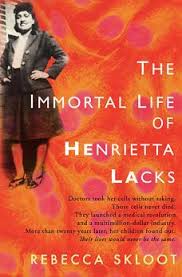
The Immortal Life of Henrietta Lacks, by Rebecca Skloot

RATING

2 stars

N/A = good but not on the scale

1 star = perspective supplementing

2 stars = perspective influencing

3 stars = perspective altering

SHORT SUMMARY  (272 words or less)

What a fantastic book.  It toes the line between incredulity and fate, as Henrietta’s story seems both from another world and also destined to influence human progress.

Henrietta Lacks is the namesake of the”HeLa” cells prolific in medical research.  HeLa cells derive from cervical cancer cells taken from Lacks in 1951.  Incredibly, HeLa cells reproduced a new generation every 24 hours and were the first immortal human cell line to sustain generational growth in lab settings.  And they are still growing today.  HeLa cells have lead to breakthroughs in biomedical technology, advancing treatments for polio, HIV, HPV, leukemia, influenza, hemophilia,  Parkinson’s, IVF, cancer, etc.

Henrietta was a young, black tobacco farmer in Baltimore who was treated for cancer at Johns Hopkins.  She was treated as well as possible for the time, but her cells were taken without her or her family’s consent (not uncommon at the time).  HeLa cells became, and still are, widely disseminated throughout labs around the world, and ultimately, biotech industries profited heavily from their distribution.

The author discusses race, economics and our institutions objectively in context of Henrietta’s story.  In a heartbreaking quote, with a complicated question, posed by Henrietta’s son:  “If our mother is so important to science, how come we can’t get health insurance?”  It makes you really think about all sides of what that means.

But, here is the mind boggling theme.  Cells from a woman who died tragically young from cancer continue to change the world 66+ years after her death. If there’s ever a cure for cancer, the fact that Henrietta lived on this earth will have a lot to do with it.

LONG SUMMARY

Started Feb. 16, 2017:

-At a high level, this book is about Henrietta Lacks, the forgotten donor and namesake for the HeLa cells that have revolutionized modern medicine.

-So, what are HeLa cells?  Well, it’s a human cell culture that his been grown uninterrupted, since 1951.  Before the HeLa cell culture, it was difficult for laboratories to sustain growth of human cell cultures, and thus, it was difficult for these labs to perform medical tests on drugs, therapies, and other medical modalities affecting human health.  HeLa cells were taken from patient Henrietta Lacks of Baltimore at Johns Hopkins University.  The cells are named “HeLa” due to the first two letters in Lacks’ first name combined with the first two letters of her last name.

Henrietta Lacks was diagnosed with an aggressive cervical cancer, and she died of the disease in 1951.  Her cells, though, live on.  During a surgical procedure performed while Henrietta was still alive, a sample of the cancerous cells was taken from her cervix and was grown in culture.  The cells astonishingly sustained growth and continue to grow to this day.

Thus, Henrietta Lacks is said to be “immortal” because her cells can reproduce indefinitely in culture under the right survival conditions.  In fact, more of her cells have grown after she died than ever did during her entire life.  HeLa cells are profoundly important and have advanced medicine in so many ways.  From the book, I’ve heard about their contributions to the Polio vaccine, genetic testing, AIDS research, cancer research, IVF, just to name a very few.

According to Wikipedia, to date about 20 tons of HeLa cells have been grown, and HeLa cells are present in almost 11,000 patients.

-The book is an interesting intersection between the medical benefits of Lacks’ cells and Lacks’ life and her family’s lives.  The book weaves between these two narratives eloquently and in way that is educational and captivating.  I’ll attempt to capture the points that stand out, but even without factual tidbits to take away, this book is worth the read.

-Interesting fact:  after Henrietta Lacks died, the HeLa cells were sent to the Tuskegee Institute for growth and reproduction.  The historical irony here is especially strong.  At the same time when the cells belonging to Henrietta Lacks, an African American woman from Baltimore, were being massively reproduced, the Tuskegee Institute was performing its infamous experiments where doctors unethically “treated” 600 men for syphilis.  These men were not told that they were not being treated for syphilis (and instead being treated for something else) or that they were being treated using ineffective means (after penicillin was known to be a cure for the particular disease).

-The experiments by Chester Southam.  This is actually kind of a crazy, fucked up side story.  This Dr. Southam at Sloan Kettering wanted to know whether researches who were handling HeLa cells were susceptible to contracting an infection or cancer.  So this guy proceeds to inject several sick women with HeLa cells, without their consent, to see if cancer would grow.  In some women it did grow and at least with one woman, it metastasized.  He then wanted to inject healthy people with HeLa cells, so we went to the Ohio prison system and got healthy men to volunteer for the injections.   When he found that many of the healthy men’s immune fought off the HeLa cells, he then proceeded to expand his experimentation on other health populations outside of prison, back at Sloan Kettering and then later at Jewish Chronic Disease Hospital.  At this hospital, a few of Southam’s colleagues blew the whistle, mainly because they remembered the implications at Nuremberg (these experiments were conducted in the mid 50s and 60s).  During the Nuremberg trials, several Nazi doctors were sentenced for hanging for their grotesque experiments during the Holocaust.  From these trials, the notion of “informed consent” became a benchmark for medical practice, something that the Hippocratic oath did not speak to.  Soonafter, the whistle blowing, Southam was investigated by the Board of Regents at the University of the State of New York and he was found guilty of unprofessionalism and deceit.  His license was suspended for one year.  But here’s the crazy part–he was later renamed president of the American Cancer Society.

-HeLa cells were sent to space by the Soviets in 1960 n Sputnik 2.  It was discovered that HeLa cells actually grow more aggressively in space than on Earth.

-The “HeLa bomb”– during a conference in 1966, a scientist announced that all of his human cell cultures, which he thought was free of HeLa cells, was actually contaminated by HeLa.  The scientist discovered this because all of his human cells had a genetic marker, G6PD-A, which was indicative of African American cellular origin.  HeLa cells would grow aggressively in culture and take over all other cells.  I’m not exactly sure how it works, but I think it had something to do with HeLa cells starting the cell culture and then the idea was that other human cells would grow in the culture, with HeLa being removed.  This discovery was known as the HeLa bomb because in labs across the world, when scientists thought that they were growing human cell cultures free from HeLa, many of the cell cultures were actually taken over by HeLa.  This was detectable by testing for the G6PS-A marker.

-Spontaneous transformation refuted.  Because HeLa cells had been discovered to have taken over a lot of human cell cultures, the theory of spontaneous transformation in cancer growth was disproved.  Basically they theory was that in human cell culutres that were thought to be free of HeLa, normal cells would spontaneously transform to be cancerous. The idea was that if scientists could identify the moment of transformation, they could determine the mechanism to attack cancer.  However, the HeLa bomb disproved this and showed that the cells that underwent what was thought to be “spontaneous transformation” were actually HeLa cells taking over.

-The book does a really great job weaving the narratives of the Henrietta Lacks’ family together where her larger medical story and the story of HeLa cells.  I really enjoy this about the book.  That it does not water down the complex relationship between race and economics against power institutions.  One interesting point of discussion is author’s explanation of a long and troubled history between certain minority communities and prominent hospitals, including the mistrust between African Americans in Baltimore and Johns Hopkins University.  The author gets into details of the history of medical institutions and how the treatment of blacks, both very real and also imagined, fed into this deep mistrust.  A particular telling example of this is the anger that the Lacks’ family had (has?) towards Henrietta’s cells being used for scientific research (and profit) without what they believe to have been proper consent.

-In one very telling quote:  “If our mother is so important to science, how come we can’t get health insurance?”

-The author goes into the interesting legal landscape regarding ownership of cell lines.  HeLa cells were not the only cells to be contested regarding ownership.  The “Mo cell line” named after John Moore was the subject of an important legal debate.  Moore had gone to UCLA for treatment of a rare form of leukemia.  In a riveting series of events, eventually Moore discovered that his doctor at UCLA was growing and maintaining his cell line due to its very valuable traits.  In particular, the Mo cell line grew particular proteins that stimulated the growth of white blood cells.  The doctor at UCLA profited from this cell line, contracting with a biotech company for millions of dollars for access.  Moore sued the UCLA doctor on the grounds that the commercial value of his cell lines were withheld from him, and thus we did not (and was not able to) give informed consent.  He lost the initial court battle, but later won the appeal where a California court ruled that he had rights to profits derived his cell line, even in spite of the Mo patent.  Ultimately, though, the California Supreme Court held that the Moore had no rights to profits derived from his discarded cells.  The court did hold that the doctor breached his fiduciary duty to reveal his financial gains and potentials from the Mo line.

-Back in Baltimore, the Lacks’ family was not following the Mo line case, but they were lobbying for JHU to give them what they believed was their fair share of profits.  The argument is an interesting one:  on one had, setting up a legal regime to prevent growth of cell lines may impede scientific progress, but on the other hand, the ownership battles that biotech and pharma companies already engage in impede this progress.  So you can’t solely use the argument for scientific advancement to justify the social, legal and moral cost of not addressing the issue of proper ownership of your own cells.  Moreover, Henrietta Lacks’ was in a unique situation compared to the Mo line.  In the Mo line case, Moore was still alive and thus as a living patient was able to at least legally challenge the proprietary and profitable nature of his cellular line.  Henrietta Lacks had died while her cells proliferated.  What type of legal avenues are available for this scenario?

-Interesting discussion about HeLa cells and how some scientists have tried to classify them as an entirely new non-human species due to their immortality and growth properties.

-HeLa cells were used to develop the HPV vaccine and also used for significant AIDS research.  I’ll probably look this up, but I wonder how many Nobel Prizes were based on work done using HeLa cells at the very least.

-Hayflick Limit:  The number of times that a cell can divide before division reaches its limit.  This has to do with telomeres which are strings of DNA at the end of chromosones that dictate how many more times a cell can divide.  As cells go through their normal lives, their telomeres shorten which each division until they die.  The length of telomeres correlates with a person’s age, as the older they get, the less number of rounds of divisions their cells have.  Cancer cells have an enzyme called telomerase, which rebuilds the cells telomeres.

-It must have been maddening to be in the Lacks’ family’s position once they started finding out how famous and important Henrietta’s cell became. The continuous refrain seemed to be that HeLa cells advanced medical science so significantly and literally formed industries in biotech, but their family did not see a penny of that.  It’s a tough argument–monetary and scientific benefits from HeLa were diffused and there wasn’t a pile of cash just sitting somewhere, but still, there is a base level of empathy you can have there.

-The legacy of HeLa cells is remarkable–they have lead to treatments (and cures in some cases) for polio, HIV treatments, HPV, leukemia, influenza, hemophilia,  Parkinson’s, IVF, cancer, STDs, appendicitis, etc.  An apt quote from the book–if there is ever a cure for cancer, it will be in large part due to Henrietta Lacks.  HeLa cells also lead to discussions and ultimate reforms in medical ethics and procedures and practices around patient consent.

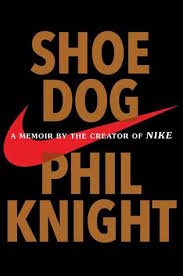
Shoe Dog, by Phil Knight

RATING

1 star

N/A = good but not on the scale

1 star = perspective supplementing

2 stars = perspective influencing

3 stars = perspective altering

SHORT SUMMARY

This book was interesting, especially given my profession.  I did appreciate Knight’s honesty throughout the book, of the trials by fire that he went through to learn the business.  That is not very uncommon, I know, but it was interesting to read about.  There weren’t any profound life philosophies that I gleaned from reading the book, but there were a few themes that emerged for me.

One:  throughout his early career, Knight often referred back to his travel around the world when he was in his early 20s.  Sometimes the macro-insights made its way into his business thinking, but often it was lurking in the background, a calibration of his world view that made him think or respond in certain ways.  I have often said how I believe that every action you take, big and small, meaningful and meaningless. is the culmination of an entire life’s experience.  I feel like Knight was honest about the background philosophies and life experiences that shaped and informed who he was as a person outside of a businessman.

Two:  Everything in business comes down to supply and demand.  High demand without supply to meet it; high supply without demand to meet it; etc.  Seems so basic, but it’s so fundamental.

Three:  Inspiration can come at a moment’s notice.  E.g., the name “Nike” was selected almost whimsically.  Inspiration can also be a methodical grind.  It took Knights company years to become an overnight success.

All in all, this is a good book.  Worth reading, if anything to learn about an interesting journey for the start a development of a successful business.

LONG SUMMARY

Started December 8, 2016:

-From the outset, I should say, that it is interesting reading this book.  In full disclosure, I work for Under Armour.  The opinions I discuss here are solely my own and do not reflect those of Under Armour.  Any observations or comments I make here are my own objective comments and do not reflect any larger insight into Under Armour or any other relationship.  I am reading and writing about this book merely for educational purposes.

-The foreword to this book is pretty good.  There were interesting life analogies to running that I can relate to, particularly the idea that running a certain distance isn’t about where you’re going, it’s about being afraid of stopping.  So mile after mile, you keep going, and realize that it’s the journey that’s valuable.

-Phil Knight grew up in Portland, attended the University of Oregon and then Stanford business school.  At Stanford, he had pitched an idea about importing Japanese running shoes and selling them in the US at prices that undercut Adidas.

-After Stanford, Knight planned a round the world trip with a business school buddy.  They made it only to Hawaii after his friend found a girl, and he decided to book a flight to Japan to talk about his business idea to a Japanese shoe making company (Tiger).

-Blue Ribbon Sports–the name originated on-the-fly after Knight met with Japanese shoe execs and they asked for the name of his business.

-Interesting backdrop of WWII.  Knights visit to Japan was in the early 1960s, and though it’s a little hard to imagine now, the emotions of WWII were still in the air between both sides.

-After the meeting, Knight continued on his round the world journey.  I think it’s interesting how these travels at an early age may have influenced his vision.

-Knight comes back from his trip and doesn’t hear back from Tiger.  He soon decides to pursue a career as a CPA, but after a while, he receives a small shipment from the company.  He sends a pair to his old track coach at Oregon and after a while, they decide to enter into a business partnership.  Lesson:  you never know who from your prior life will be along your side in a new chapter.

-The sales of Tiger shoes goes well.  However, after a while, Knight has to go back to Japan to meet with the company to negotiate becoming the exclusive Western US shoe distributor.  Initially Knight thinks that the meeting does not go well.  There’s a good quote in there that I like–something about how happiness seems to dull the senses and also how victory seems to dull the beauty in the world.  Tiger ultimately agrees for Blue Ribbon to be the exclusive shoe dealer in the Western US.

-It’s been a while since I posted, and I’ve gone through a significant chunk of the book.  In between have been descriptions of how Knight worked as a CPA during as a day job and ran Blue Ribbon on the side.  Eventually, Knight left his accounting job and got a job as an accounting professor at Oregon State, where he met his wife.

-Blue Ribbon went back to Onitsuka (the company that made the Tiger shoes) and secured rights to sell on the US East Coast.  Knight had to come up with a story on the spot about how Blue Ribbon had East Coast offices, when in fact there were only 3 or 4 employees at the company (Knight, Bill Bowerman, Jeff Johnson, Bob Woodell), none of whom lived on the East Coast.  Nevertheless, Blue Ribbon secured the rights.

-One thing that I like about this book is Knight’s honesty.  He talks about his failures with as much candidness as his successes, and that makes for an interesting story to read.  Another interesting point–Knight says that he wished he kept a journal, particularly from dinners he would have with his business partner Woodell.

-Interesting story about the Cortes shoe.  Blue Ribbon was originally going to name it the shoe the Aztec for the 1968 Mexico City Olympics, but Adidas had a similar sounding shoe and they threatened legal action against Blue Ribbon.  So Blue Ribbon used the name Cortes after the conquistador.

-Blue Ribbon struggles to get continued financing, despite it’s growth numbers.  Their bank is hesitant to lend credit due to the zero cash balance on the books–all moneies from sales are reinvested into growing the business.  Blue Ribbon tries a stock offering in the nascent venture capital world, but they get zero bidders.  Eventually Woodell’s parents give Knight an $8000 loan to keep the business going.

-The relationship between Blue Ribbon and Onitsuka strains, especially after a visit to the US by the Onitsuka chairman.  Blue Ribbon finds out that Onitsuka is visiting more than a dozen Tiger distributors in the US.  I appreciate the honesty that Knight describes in this encounter–how he reluctantly and regrettably stole a folder from the chairman’s briefcase during their visit to glean this information.  The level of honesty and ability to admit actions in moral gray area makes this story captivating.

-Eventually Knight realizes that Blue Ribbon’s relationship with Onitsuka has to end, but it can’t end yet until Blue Ribbon has a back up plan for suppliers.  Blue Ribbon considers working with a Japanese holding company that can connect them with other shoe manufacturers in Japan.  Knight thinks about that.  In the meantime, he goes to a distributor in Mexico (the distributor is called “Canada”) and contracts with them to manufacture football shoes, which are eventually worn by Notre Dame’s QB in 1971.  Admittedly by Knight, the shoes were not great.  But one thing born from this purchase was Blue Ribbon’s renaming to Nike.

-The name Nike came about kind of at random.  Knight was thinking of a new name to rebrand the shoes developed the Mexican manufacturer.  The first choices were Falcon and Dimension Six.  Knight was lobbying hard for Dimension Six, but everyone in the small company thought it was a terrible name.  They eventually crowd sourced the naming to the entire company, but did not have any captivating names.  The day before Knight was to inform the manufacturer of the new name, Woodell tells Knight that Johnson dreamed the name Nike.  Knight is honest about the randomness in why he picked that name.  He says he’d like to think that it reminded him of his travels to the Acropolis, memories of Churchill’s quotes on victory, the presence of the goddess Athena Nike on distinguished medals.  The reality seems to be that the choice was somewhat impromptu.  Still, though, there is something mythical about the story of dreaming the name.

-Also the development of the Nike checkmark logo is interesting.  Blue Ribbon hired a designer to develop a logo that looked fast and conveyed speed.  Blue Ribbon eventually paid $35 for the logo, and Knight wasn’t particularly fond of it, but was convinced by others that it was alright.

-Two quotes I like (don’t remember the exact quotes, but they go something like):

Confidence is like money, you need some to get some more, and people are loathe to give it to you.

Some of the most important statements in life are spoken softly.

-Nike turns a corner.  Knight finds an alternative manufacturer in Japan and the company displays the shoes at a Chicago running conference.  The buzz goes well, even though Knight admits that the shoes don’t look great.  Onitsuka finds out about the other supplier and terminates their engagement with Nike/Blue Ribbon.

-Knight makes a decisive call to action for his young company at this moment–that Onitsuka’s withdrawal causes uncertainty in an uncertain time, but indicates to his employees that the time is there for them to build something new from scratch.

-Knight and colleagues work to have a presence at the US Trials in Eugene before the 1972 Olympics.  They have a few people wear their shoes.

-Nike gets their first patent on the polyurethane waffle shoe design.  The first design was literally made in a waffle iron by Bowerman.

-Nike’s first athlete endorsement  was a Romanian tennis player.  Nike paid him $10,000.  Later, Nike had the University of Oregon football team wear shoes.

Podcast: Planet Money – The Chicken Tax

Podcast introduces an interesting question:  when you think of mid-size sedans in the US, you can name a bunch of models made by both foreign and domestic car companies.  But when you think of pickup trucks, you only really think about US companies.


Why do US automotive companies dominate the US pickup truck market in this way?  It has to do with a tariff known as the chicken tax.


A tariff is basically a tax on importing goods and services into the United States.  In the post-war 1950s, VW Beatles and Vans were common place in the US.  In a seemingly unrelated tangent, the US chicken industry was selling massive amounts of frozen chicken in the West German market.  After the chicken-craze took over West Germany, West Germans tried to domestically produce chickens and to bolster this industry, West Germany and France imposed a tariff on US chicken.  The US chicken industry got upset at this and the US Government (Lyndon Johnson) retaliated with a tariff on any imported automobiles that were used for primary commercial purposes (i.e,. commercial vans and pickup trucks).  The tariff as a 25% tax on these foreign automotives.  This made the US market costly for foreign companies to compete in the pickup truck space.


Foreign companies tried avoiding this by shipping parts to the US and having them assembled in the US.  Most of the time, this did not work, and US Customs enforced the tariffs on the parts too.  Under NAFTA, though, manufacturers in NAFTA countries were able to ship assembled pickup trucks to the US without any tariff.  Thus, many autocompanies manufacture pickup trucks in Mexico and ship to the US to avoid the tariff.  Domestic companies do this, but so do foreign companies.