RATING
3 stars
N/A = good but not on the scale
1 star = perspective supplementing
2 stars = perspective influencing
3 stars = perspective altering
SHORT SUMMARY (272 words or less)
—
Perhaps no President has rehabilitated his historical image as drastically in such a short time as President George W. Bush. Even if you didn’t like his policies or didn’t vote for him, the contrast between him and President Trump is stark. It neutralizes (or at least gives you selective amnesia) on the missteps during W’s administration. This book takes a historical reflection, two decades in the making, on perhaps the biggest unforced error in US foreign policy in the 21st century–the US invasion of Iraq in March 2003.
I was a college freshman on 9/11 and a sophomore when President Bush gave his St. Patrick’s Day address to the country announcing an invasion of Iraq. That by itself took me on a trip down memory lane.
However, as important as that historical context is, this book gets two stars because of its commentary on the perils of Bush’s style of leadership. After 9/11, Bush displayed a previously unseen streak of decisiveness, eloquence, unity, and clarity of purpose. That was very well received by the public, especially after the divisive 2000 election and Florida recount. But as he pivoted to Iraq, it seemed like his mind was made up beforehand and the facts were secondary. Repeatedly, the book recounts how his administration encouraged compliance and how his cabinet was incentivized to give thoughts on what they thought their boss would want to hear, rather than what their boss needed to hear.
We’ve all had “bad bosses” in our careers. This book is ultimately a lesson in management–surround yourself with diverse opinions, listen to dissenters, gather the facts, and *then* be decisive.
—
LONGER SUMMARY
I first heard about this book while listening to Ezra Klein’s podcast, where Robert Draper was a guest. As Draper was discussing the book, Klein made a comment that resonated with me. Like me, he was in college during the (second) Iraq War, and revisiting this moment in US history decades later was an insightful, 20/20 hindsight trip down memory lane. I remember attending anti-war protests in Ann Arbor, arguing with roommates and classmates about the legitimacy of the Iraq threat, learning that friends I grew up with were about to be deployed for their first of several tours in Iraq. I remember feeling like we were experiencing this bizarre overreaction to the fresh wounds of 9/11.
But stopping at that would give me too much credit. I also remember being in a haze, honestly not quite sure what to make of the world. I don’t think that I opposed the war because I had such great intellectual foresight on the future consequences to US foreign policy. I think I mostly opposed the war because I kind of felt like it was wrong, but I couldn’t really articulate why, and my 19 year old self wanted a reason to protest against the Bush administration. If history had borne out the Iraq war to be the right decision, my protests would look foolish and incomplete. in fact, I’ve already felt this way with some of my young adult views–in the months after 9/11, I also opposed and protested the US invasion of Afghanistan, and looking back at that position with hindsight, history would surely tell us that I was very naive and incorrect.
But in 2003, as a sophomore in college, during the Iraq War debate, it just felt like something was different and something was wrong. I remember that feeling vividly, like it just felt like there was this drumbeat to war. You first would hear about Iraq after 9/11 and think something like “hmm…that’s interesting” and how an invasion eventually evolved into an inevitability. You went from speculating whether Bush would launch a war in the Middle East to assuming that it was certain to happen. The needle on the public perception seemed to move so incrementally, kind of like the analogy of a frog in a pot of water with the temperature turned up one degree at a time. And as gradual as this perception shifted, looking back, I also just remembering this feeling that this country wanted revenge, and that Afghanistan was not enough. Looking back, and reading this book, it feels like that public mentality set the conditions for a flimsily justified war. Or more cynically, it feels like that public mentality was exploited to fit a world view and perception towards Iraq and the Middle East that existed long before the hijackers flew planes into the twin towers on that terrible day.
A few things struck me while I read this book. The most important was how this book was a primer and a cautionary tale about the perils of presumptive management. I won’t summarize the details of the book here, but the big takeaway–almost immediately after 9/11, a snow ball started within the Bush administration for justification to take the country to war in Iraq. Some of that was a consequence of the new, post-9/11 world and the exigent need to keep the homeland safe in the wake of the terror attacks. But some of that was also a consequence of residual thinking, from the post-Cold War hegemony through the neo-conservative perspective to the lessons of the first Iraq War. Also, it made me wonder, what kind of psychology played into W’s decision, seeing his father triumph in the first major US conflict since Vietnam only to watch him lose reelection to Bill Clinton a year later.
The bottom line, for me, the atmosphere of management by President George W. Bush created an environment where preconceived conclusions came first and justifications were made to back into those conclusions, where dissent and diversity of opinion were not encouraged, and where those who had the opportunity to push back either didn’t do so at the right time, tried to thread an impossible needle to gain political standing, or simply stayed silent because it wouldn’t have mattered. At many times in the book, it seemed like people in the administration knew what the power players wanted to hear, and those people were lining up arguments to play to those conclusions rather than to provide objective facts. I know that happens all the time, in politics and in business, but when it is *war* that is at stake that atmosphere can be disastrous.
In a weird way, with some reflection, I feel like it’s both incredulous that we went to war in Iraq and also obvious that we would have gone to war in Iraq. I think about how we’re living through this COVID pandemic and how we as a country have not had that post 9/11 moment of national unity–maybe because times have changed or maybe because this pandemic isn’t a sudden discrete and scarring event like September 11, 2001 was. That moment of national unity in 2001 bestowed upon this country international capital and goodwill, and we could use it to bring justice, to wage war, to promote American and western ideals across the world. But also, that moment of national unity ultimately suppressed political dissent. I distinctly remember feeling that if you were against the war in Iraq, it was likely that you would be cast as un-American or at the very least, unsupportive of our troops. It seems trivial now, but when Barack Obama said in his famous convention speech in 2004 that “there are patriots who supported the war in Iraq and there are patriots who opposed the war in Iraq” — it was the first time that I felt like dissent could be patriotic.
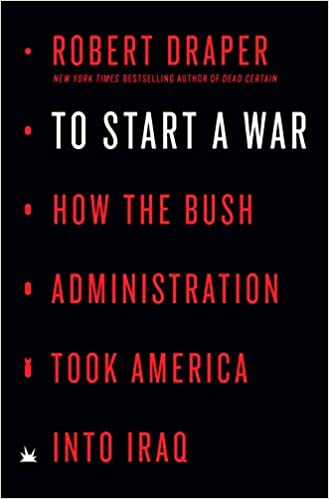
This book is about how we went to war. Who the people were, how the argument was framed, how the case was made to the American public. President Bush seemed like a thoughtful and analytical president (moreso than I gave him credit for 20 years ago), but also his administration seemed to manage with a style that was incapable of listening to differing opinions. As I read the book, I thought of the different jobs and management situations that I have experienced throughout my career. Decisiveness is something valued from a leader, but if you have a leader who will not listen to a diverse set of perspectives and who will not encourage dissent, then eventually your organization or team is going to speak to what they *think* their leader wants to hear, not what they actually think is best for the group. It seems to me, this was how Bush’s defense team was set up–the bullying nature of Sec. Def. Rumsfeld; the strong headedness of VP Cheney; the caught-in-the-middle role of Sec. State Powell and NSC Advisor Rice; the political pressure to conform as experienced by Senators Clinton, Daschle and the 75 other senators who authorized the war resolution in October 2002 . The list goes on.
And maybe you can’t blame the conformity–in the fog of war, with the wounds being fresh, who would want to be on the wrong side of history, if being on the wrong side meant an attack on the homeland. Who would have acted differently a second time around? After all, the 2001 Congressional Authorization for Use of Military Force became law in the week after 9/11 with only a single “no” vote in the entirety of the US Congress. Who would have the foresight to say no or to take more time to review in a moment like that? Perhaps it’s a lesson for all of us. When we find ourselves in situations where we are in the fog, how can we keep a level head and consider all the facts, even if the waters around us are flowing strongly and swiftly in one direction.
It’s probably unavoidable to have leaders who may govern like this. And often, decisiveness will carry the day, because the wins will outpace the losses. But every now and then, you’ll have situations where the loss that is at stake is so monumental. It might be politically ok to hold your line before the facts on things like fiscal policy or the national debt or economic regulations, but every now and then, if you get something really big wrong, like going to war on false pretenses, the country will pay an enormous cost. In the case of the Iraq war, the cost was 1M dead, $1 trillion spent, and a generational loss of US goodwill around the world.
After reading this book, I just pray that when we happen to be in those monumental situations, we find ourselves with leaders who will listen to disagreements and differing opinions and will take time to listen to facts. But as the mismanaged federal response to the COVID-19 pandemic has shown, history is certainly bound to repeat itself.
 Book Summaries. Less than 272 words.
One thought on “To Start A War, By Robert Draper”