Scribbles
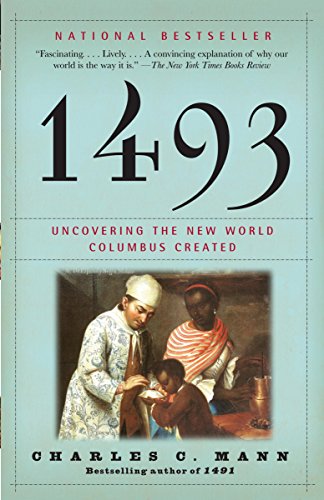
-The foreword and introduction to this book is thought provoking. It casts Columbus’s “discovery” of the New World in historical perspective, that world history from an ecological and economic perspective can be divided along pre-Colombian exchange and post-Colombian exchange lines. The author states that for all the historical triumphs and tragedies that Columbus is responsible for, perhaps no one man on Earth played a more important role in kick starting a new age than Columbus did with his discovery.
-The author refers to the ecological and economic age that Columbus ushered in as the homogenoscene. More information here.
-The book goes through a quick history from Columbus to Cortez conquering South America. I zoned out a bit, but picked it back up in the mid-16th century description of how silver mined in S. America fueled vast amounts of Spanish wealth. The silver was traded all over the world, and Spain rose to an incredible global power as a result. This lead to numerous wars between the Spanish armies and various armies cross Europe. The author makes a comment that European powers had always been at war, but this was the first time in history that they were a result of events occurring across the continent. Takeaway–Spanish silver ruled the 16th century!
-The author discusses the “Little Ice Age” that, according to a Google search I did, lasted from 1645 to 1715. There are many theories for why this climate cooling happened (fewer sunspots, volcanic eruptions), but the author highlights one theory that is gaining traction. Indigenous Indians in North America would frequently perform ritualistic and harvest-driven burnings of prairie lands. When these Indian populations were killed and wiped out by disease, these burnings stopped, and the prairie lands in the Mid were over taken by forest (namely fire-hating woods like Oak replacing fire-hungry plants and shrubs). The theory goes that the overtaking of forest lands in these areas decreased overall carbon output and triggered a global cooling. More information found here: here.
-As the author wraps up the introduction, a few things are clear. Silver mined in the Americas had a global economic impact. The introduction of diseases in the Americas not only decimated local populations but also contributed to a cascade of events resulting in the slave trade (e.g., malaria in New England made it hard for Europeans and Dutch to bring workers over, so they “purchased” human slaves from Africa). Columbus landing in the New World was the very first step in a new age for the planet–one dominated by economic and ecological mixing between East and West and the resulting consequences.
 Book Summaries. Less than 272 words.
One thought on “1493: Uncovering the New World Columbus Created, by Charles Mann”