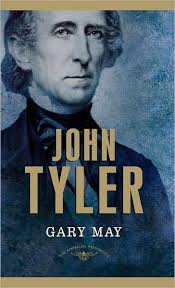
SCRIBBLES (notes as I read along)
–John Tyler ascended to the presidency when William Henry Harrison died in office, the first time in US History that a president died in office. So we were in uncharted territory.
-When Harrison got sick from pneumonia, they tried a bunch of crude medical cures, including, for example, “swallowing ipecac, opium and brandy and mixtures of petroleum and snakeweed.” This likely accelerated his death.
-When Tyler assumed the presidency, he belonged to the Whig party, whose main intellect and leader was perpetual presidential candidate Senator Henry Clay of Kentucky. The Whigs believed in a weak presidency dominated by a strong congress.
-Since this was the first time a president died in office, Tyler knew that his actions would serve as precedent for successors. The Constitution was a bit unclear about presidential succession (the 25th Amendment, adopted in 1967, clarified this). The issue was Article 2, Section 1, which said that “in the case of removal of the President from Office, or of his Death, Resignation, or Inability to discharge the Power and Duties of said office, the Same shall devolve on the Vice President.” The question was what the words “the same” referred to. Did it refer to the entire office of the presidency or just to the power and duties? Also at issue was the 12th Amendment (ratified in 1802 in response to the 1800 election when Jefferson tied with his vice president Aaron Burr). The 12th amendment said that the “Vice-President shall act as President.” It said “shall act” and not “become.”
-Tyler made an early decision that he was the president. He told his cabinet to resign if anyone disagreed . No one resigned.
-Tyler became the youngest president to hold the office at that time in US History. I looked it up, the oldest was 68 at the time who happened to be William Henry Harrison. Another trivia question–Trump is the oldest president to ever be elected (70 years, 220 days) and Teddy Roosevelt was the youngest to be elected (42 years, 322 days).
-Tyler met Thomas Jefferson early in his life when Jefferson visited the Tyler home. Tyler’s father was the governor of Virginia, and Jefferson and Governor Tyler were law students together.
-John Tyler’s mother died when he was seven years old.
-John Tyler’s father opposed the ratification of the Constitution.
-The young Tyler followed the views of Virginia republicanism–states’ rights, limited government, a strict interpretation of the Constitution, and the preservation of slavery. Tyler was also a fan of Adam Smith’s “Wealth of Nations” and incorporated passages from it in various presidential addresses later in life.
-When Tyler was at William and Mary he adopted ideas of divine right to American expansionism–maybe something that would rear its head in his acquisition of Texas as president.
-John Tyler married Letitia Christian–she came from an affluent plantation owning family.
-Tyler joined the “Second War of Independence” (the War of 1812) but his service was undistinguished. He joined some of his countrymen in Williamsburg and waited for battle while staying at a dorm in William and Mary–they thought the British were coming, but there were no British in sight. That was the extent of his service during the war.
-Tyler won elections to the House of Delegates in Virginia four times. He later ran for a US representative seat and won at the age of 26.
-Henry Clay from Kentucky was a powerful speaker of the House when Tyler was elected. The War of 1812 reshaped many people’s views of a strong central government–believing that it was necessary for the country to survive. Clay was an advocate of a strong army and navy, development of manufacturing and industry, a system of internal improvements–canals, roads, turnpikes, etc., and a strong central government was the only entity capable of delivering. Clay called this the new “American System.” Among the things he advocated for was a strong central bank–something that would be a contentious political issue for years.
-Tyler had to choose between this expansive view and the commitment for states’ rights espoused from his Virginia and Richmond origins. Tyler choose the later, which put him at odds with Clay.
-A depression hit the country in 1818 and Tyler was in charge of investigating the Second Bank of the United States and it’s role in the economic collapse. Tyler eventually called for the abolition of the bank and removal of its revenues to state banks.
-Tyler remained orthodox against the American System, moreso than other prominent Republicans at the time who were changing–Madison and Monroe. Tyler considered the bank to be the original sin against the Constitution.
-Ultimately the constitutionality of the bank was upheld in the US Supreme Court case of McCulloch v. Maryland.
-Another big challenge while Tyler was in office: his views on slavery as it related to expansion. Tyler voted “no” on an amendment offered by a NY congressman to prohibit further importation of slaves into Missouri. The amendment eventually failed.
-Missouri became a very contentious issue. It threatened to disturb a precarious balance between free and slave states. Southern states thought the Missouri’s admission into the Union was a ploy by northern States to end Virginia’s dominance of the presidency and the South’s future control of Congress.
-Tyler was a slave owner who believed that slavery was inherently evil but part of the southern way of life (and thus couldn’t live without it). He lived with forty slaves and they made his financial success possible. He kept his slaves in bondage despite his belief in himself as a “slave owner with a conscious.” There is a quote in the book–that the men of the time were “men made of slaves.” They could not prosper or survive without them.
-Back to Missouri. In 1820, eventually Missouri was admitted as a slave state as a compromise for Maine being admitted as a free state. This would keep the balance of states between slave and free in the Union. As an additional condition to the Missouri Compromise, slavery would be forbidden from taking root anywhere in the Louisiana Purchase north of the the 36’30” parallel (with the exception of Missouri).
-Tyler spoke to the House in defense of slavery, citing Article IV Section 2 of the Constitution as requiring slaves who escaped their masters to be returned. In an argument whose logic that I do not follow, Tyler argued that by restricting the expansion of slavery, the government could then seize at will the property of any citizen. Also, Tyler alleged that the Louisiana Purchase was made with money provided by both the Northern and Southern states and that the compromise was robbing the South of its fair share. Funny how fairness is invoked here.
-Tyler believed in a diffusion theory of slavery like his predecessors Jefferson and Madison. The diffusion theory went like this: if slavery was indeed a dark cloud, then slavery would be allowed to spread such that the cloud was diffused. The thought is that the diffusion would lead to eventual abolition because a flourishing slave trade would make slaves more valuable to their owners, and thus owners would be less inclined to harm them. Tyler actually makes the argument that the Missouri Compromise lessens the likelihood that slaves would eventually be emancipated because it limits the diffusion theory.
-Tyler was demoralized by the Missouri Compromise, passed in 1820, and decided not to seek reelection.
-Tyler returned to state politics and was eventually elected governor of Virginia in 1825–a post held by Jefferson and by Tyler’s father.
-A few years later, a senate opportunity opened up. Senator John Randolph was turning out to be a terrible senator. He was eventually challenged to a duel by Henry Clay. They fired shots, no one was hurt, but Randolph was done as a senator. Tyler ran against Randolph and defeated him by five votes (I believe this election was done in the Virginia House of Delegates, not a direct election). Tyler became senator at the age of 36.
-Tyler could not support himself financially in DC, so in order to raise money, he sold his most prized slave Ann Eliza. He tried to sell her to family and then friends, but none of them wanted her, so he sold her in public auction. He describes the necessity of needing to sell her at auction so that he could “meet the demands of my trip.” The author of the book makes a strong point here: “Tyler began his Senate career with monies generated by the sale of a human being.”
-Tyler came to the Senate during the political revolution of Jackson’s presidency. Jackson’s actions during the War of 1812 (particularly the hanging of British spies in Florida without government permission) were previously criticized by Tyler when he was a US Representative.
-Side note: it’s interesting to read about the rise of Jacksonian politics in today’s context of the rise of Trump populism. Jackson’s rise was fueled by the financial panic of 1819, sectional strife with the Missouri Compromise, and general popular disdain against Washington insiders. Jackson’s public persona of being a poor Carolina backcountry kid who rose to be a general and war hero resonated with the public.
-In 1824, Jackson contested the presidency, lost to John Quincy Adams. But Clay’s defeat also had big implications. Clay always had an ambition for the presidency but never attained it. Clay believed he would have won if another candidate, William Crawford, had not run and split the vote. As Speaker of the House, Clay had to decide whether to throw his weight behind Adams or Jackson, a lessor of two evils in Clay’s mind. Clay sided with Adams because they had similar economic views. This resulted in the so-called “corrupt bargain” where Clay was then appointed as Adams’ Secretary of State–a post often seen as the stepping stone to the presidency (three previous presidents had ascended from that position).
-Tyler supported Adams during the 1824 election too. He did not agree with the American System promoted by Clay and John C. Calhoun. But he hated what Jackson stood for and believed that Jackson posed a threat of “despotic rule supported by illiterate masses” (author’s quote). Tyler supported Adams believing that the close nature of the election would limit Adams reach .
-Tyler quickly grew sour on Adams. Jacksonian politics won in the off year election in 1826, setting the state for Jackson to win in 1828. Jackson won by a tricky balance conceived by Martin Van Buren–a weird alliance of Souther Jeffersonians and Northern Republicans who wanted to fight old battles against Federalism.
-Jackson won the 1828 presidency and Tyler warmed to him. Tyler ultimately aligns with Jackson on the issue of the Bank veto.
-During the nullification crisis, Tyler rejected nullification because of his Constitutional beliefs. Tyler was a strict constructionist and believed that the Constitution did not give nullifying power to the people. But he did believe in the constitutionality of secession.
-As the nullification crisis grew, Jackson submitted a “Force Bill” to the Senate declaring that states did not have the right to nullify national law. Days later, the Virginia legislature proclaimed its support for state sovereignty, forcing Tyler to take a public stand. He spoke out against the Force Bill and defended Virginia’s position on states’ rights.
-Eventually the nullification crisis ended when Clay produced a compromise tariff. But Jackson still wanted the Force Bill to go through the Senate. A lot of the supporters and opponents had left before voting, so when the final vote was given, Tyler was the only senator who voted against it even though he was not himself a nullifier. Tyler voted for Clay’s compromise tariff. The author concludes that Tyler was instrumental in bringing Clay and Calhoun to the table to work on the compromise.
-On to the Bank issue, Tyler did not support the National Bank but did not support Jackson’s unilateral action of removing federal deposits and putting them in state “pet banks.”
-Formation of the Whig Party: formed by Henry Clay’s leadership and came in response to Jackson’s unilateral actions. Tyler had clearly become an ally to the Whigs.
-Jackson was eventually censured by the Senate for his actions in withhold documents related to this withdrawal of federal funds from the National Bank. However, Jacksonian politics remained popular and shortly after the censure, a couple of senators introduced legislation to expunge the censure from the Congressional record. Tyler refused to vote for expunging the record, fearing that setting a precedent of expunging the record would lead the Senate to be a body that works in secret, but the Virginia assembly approved of it. Tyler even decided to resign from the senate instead of voting for the resolution.
-Interesting parallels to today on formation of Whig Party–the Whigs were a lose organization of political factions that were held together by their hatred of Jacksonian politics. Is there a parallel for today’s Democratic or Republican Party?
-The Whig Party was an alliance between Northern Republicans and industrialists and Southerners who broke with Jackson over the Force Bill.
-In election of 1836, Whig Party had a strategy of running so many candidates that the election would be thrown to the House of Representatives if no one got a majority of electoral votes. Strategy did not work, Martin Van Buren won, but it was close. If 1200 Pennsylvanians had switched their votes, MVB wouldn’t have obtained an electoral majority and the presidency would have been decided in the House.
-Whigs chose John Tyler as their candidate for the vice presidency and he won four states. This ultimately denied MVB’s original running mate an electoral victory to the vice presidency, but he was elected in the Senate.
-Panic of 1837 ensured. Worst American depression since the stock market crashed in 1929.
-Clay promised Tyler that he would be considered for the VP in the 1840 election. William Henry Harrison eventually selected him to help with the southern vote.
-Whig song for promoting the election of William Henry Harrison: “You’re not our man; to guide the ship; we’ll try old Tip.”
-WHH won the presidency for the Whigs but lost Virginia despite choosing Tyler as his running mate.
-After election of 1840, there was concern that Clay would really be in control of WHH.
-WHH died after a month and his funeral set precedent for future presidential funerals. The riderless horse tradition came bc the funeral procession contained Harrison’s favorite horse, Old Whitey, with stirrups up and riderless.
-House and Senate formally recognized Tyler’s lawful right to the office–no real debate about it.
-Tyler and Clay started fighting soon after. They agreed to get rid of MVB’s independent treasury but disagreed about the creation of new national bank. Tyler did not want it.
-Tyler’s slaves lived in the white house.
-Tyler had a lot of family problems with his kids after he became president. His wife became sick and ultimately died–the first First Lady to die in office.
-Clay and Tyler fight more over the bank issue. Tyler wanted to create a bank with branches in only those states that approved. Clay thought this was a weak bank, so he defied the president’s position and tried to push legislation to create a stronger bank with state branches regardless if the state approved or not. He knew that Tyler would oppose and was pushing him to a veto to try and play another “Great Compromiser” role. Clay was still ambitious for the presidency. He modified the bill a little (saying the national bank could establish branches in nonconsenting states when “necessary and proper”)–it passed the Senate and House. It was sent to Tyler and he vetoed it because he thought the bank was unconstitutional. The Democrats were hoping for the veto.
-After the veto, a mob of Whigs gathered outside the White House and threw rocks at it. They burned Tyler in effigy. Clay laughed it off, saying that the crowd was probably Democrats and not Whigs. Tyler was pissed at Clay because of the danger to his family.
-Clay rails on Tyler’s veto for months afterward.
-A once good friend of Tyler then distributes a letter called “The Coffeehouse Letter” which was extremely critical of Tyler. This lead Tyler to veto a second bank bill that reached his desk.
-Tyler’s entire cabinet (except Daniel Webster) resigned because of the second veto. Clay hoped that the cabinet resignations would cause Tyler himself to resign the presidency. Tyler reforms his cabinet. The Whigs denounce it and kick him out of their party.
-Whigs were defeated in the midterm elections.
-Tyler vetoed another Clay bill, this time on tariffs. Clay’s strategy was clear–pass any legislation that Tyler would not support and let hi veto it. The more vetoes, the better.
-International issue arose with Great Britain. Southern states became angry when a slave ship bound for slave markets in New Orleans were emancipated by the British in the Bahamas after a revolt on the ship. Tyler responded by asking for more money to build the US Navy.
-The British had the position that they had the right to stop and search vessels believed to be involved in the African slave trade. The British believed to be bound by Great Britain’s Emancipation Act of 1833 which abolished slavery. Tyler viewed the British position as amounting to impressment–one of the issues that caused the War of 1812. Eventually, the American slave owners were paid $100,000 for their loss of “property” and for the impressment issue, Britain made an informal declaration that they would not stop American ships to search for British citizens. This treaty eventually passed the senate as the “Treaty of Washington” or the “Webster-Ashburton Treaty.”
-The Treaty of Washington was popular, but that popularity did not translate to Tyler.
-Tyler Doctrine: expansion of American influence in the Pacific.
-Tyler proposes to a 22 year old. She initially says no but eventually marries Tyler.
-Tyler had a fixation on trying to annex Texas. This was controversial because of the fear that it would lead to war with Mexico. Previous US Presidents had try to acquire Texas. John Quincy Adams tried to buy part of it, but Mexico wouldn’t sell. Jackson made an attempt in 1829, but also failed because his envoy was not trusted by the Mexicans. The Texas revolt in 1835 obtained American support–including battles at the Alamo. Texas won independence in 1836 and offered itself to the United States. But then-President Jackson hesitated. The issue was slavery. Slavery was legal and flourishing in Texas. Jackson realized that annexing Texas would bring the country to the brink. Northerners opposed admitting Texas, southerners supported it and wanted to divide it into five slave owning states (to increase their power in national politics). Jackson also deferred because it was a presidential election year and thought that it might cause his successor to lose. Once MVB was elected Jackson, on his last day in office, formally recognized Texas independence. Thus, Texas was recognized for a while an independent country by the US.
-Since the US did not accept their bid to join as a state, Texas went abroad to look for allies The British received Texas warmly. Primarily because an independent Texas would block US western expansion. Also, Texas cotton would free Britain from its dependence on the American South.
-Tyler had ambitions for Texas. At first, Tyler had to tend to other issues. Sam Houston, Texas’s president offered the US to annex Texas again in 1842, Tyler turned him down. Tyler was bogged down with his problems with the Whigs, so he tried to gain support from the Democratic Party and/or forming his own party. Tyler chose Texas as the signature issue. He relied on Manifest Destiny’s captivation of the American mind to say that Texas was destined to join the US. He proclaimed it as a national security hedge against Britain. And for Northerners opposed to slavery, he offered the diffusion theory again–that slave owners would leave the South for Texas, and in doing so, they would weaken the institution. To win Northern Democrats, Tyler’s administration promised to support American claims for Oregon.
-To complicate matters further, Mexico indicated that annexation would mean war. Texas wanted an assurance of American protection before joining the US, which Tyler gave. Then, suddenly, Tyler’s secretary of state Abel Upshur, was killed on an explosion on a ship that Tyler was on. Tyler escaped harm. John C. Calhoun filled Upshur’s position as secretary of state. This was a mistake for Tyler–it secured the idea that annexation for Texas was in “southern hands.” With Calhoun as secretary of state, annexation of Texas became synonymous with expansion of slavery, which was counter to Tyler’s plan to gain a national support and coalition for annexation. Texas provided Calhoun with an even stronger demand for US military protection and Tyler gave it. Tyler wanted Texas one way or another. The treaty to annex Texas was sent to the Senate on April 12, 1844.
-Clay announced his opposition to the treaty to annex. Clay was the Whig nominee in 1844 for President. Tyler responded by forming his own party (a reincarnation of the Democratic-Republican Party) to play spoiler. Democrats who endorsed annexation would support him. The rest of the Democrats united their support around James K. Polk over Martin Van Buren (side note: Polk was the first “dark horse” candidate). Polk was a slave owner from Tennessee and an expansionist. If Tyler stayed in the race, he would draw votes from Polk, handing the presidency to Clay and thus ending his dreams for Texas. Tyler proclaimed that he’d rather have the treaty ratified than win the presidency. The treaty, however, was defeated in the Senate.
-In between all of this, Tyler gets married, the first to marry in office.
-Tyler worked to build up his Democratic-Republican Party and pushed to challenge Polk to force his hand on the annexation issue. Eventually Tyler and Polk worked out a clandestine agreement that Tyler would withdraw if Polk agreed to support annexation. Tyler agreed and thus had another first: first incumbent to not seek a second term.
-Polk narrowly defeated Clay in the 1844 election. Kind of amazing that Clay never became President when you think about it.
-President-elect Polk promptly threw his weight to Tyler and asked the House and Senate to annex Texas. The house resolution passed and the prospects in the Senate were close. A resolution was passed as a “compromise” with the Whigs. The resolution said that the president could either annex Texas by resolution or reopen negotiations. A few Southern Whigs and Northern Democrats who were opposed to annexation agreed b/c they thought that annexation wouldn’t happen and would fall through when renegotiations opened up. The thought was that the choice would be made by the new President Polk. However, Tyler did not want to share any glory of annexation with Polk, so Tyler signed the resolution for annexation three days before leaving office. The annexation eventually lead to war with Mexico.
-Before Tyler left office he had another presidential first. The first president to have a veto that was overrode by Congress.
-During his post-presidency, as the country moved towards Civil War, Tyler firmly supported slave expansion and advocated supporting candidates sympathetic to that cause. He tried to advocated by keeping the Union together through a proposed “peace conference” but ultimately this was not successful. He eventually joined the secessionists. He joined 87 other delates to the Virginia state convention to approve an ordinance of secession. Tyler advocated for border states to join the Confederacy. Tyler oversaw Virginia joining the Confederacy and oversaw the transition of the capital from Montgomery to Richmond. He served in the Confederacy’s provisional congress. In the author’s view, Tyler became the “first president to betray the country he spent his life serving.” Tyler sought elective office, eventually wining a seat in the Confederate House of Representatives.
-When Tyler died, there was no White House funeral for him. No flags flew at half staff. The Lincoln government took no formal notice of his death. There were few public obituaries. Tyler received a Southern farewell, his open coffin draped in the Confederate Flag and lay in state in Richmond’s Hall of Congress. Jefferson Davis and Alexander Stephens (Davis’s VP) attended. His funeral had a lot of attention in Confederate Virginia.
 Book Summaries. Less than 272 words.
2 thoughts on “John Tyler, By Gary May”