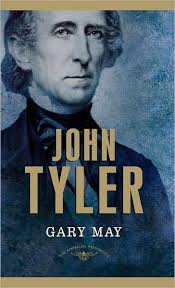
RATING
N/A
N/A = good but not on the scale
1 star = perspective supplementing
2 stars = perspective influencing
3 stars = perspective altering
SHORT SUMMARY (272 words or less)
John Tyler was not a good President. His time in office was filled with many firsts, derived mostly from happenstance. The first president to: ascend to the Office upon the death of a President, be excommunicated by his own party, have a wife die in office, (re)marry in office, have a congressional override of a veto, avoid seeking a second term, and the most distinct honor of all, the first (and only) US President to support and serve for the Confederate States of America. If those are the highlights for a President’s term, you know you’re dealing with a bad one.
Tyler’s biggest presidential accomplishment was the annexation of Texas. His predecessors weighed on this issue hesitantly; Tyler pulled the trigger. Tyler thought his legacy would be cemented with annexation. Instead, it added more kindling for the fire and the fractious drumbeat for Civil War. And later in life, when it came to his stance on that terrible war, he initially advocated for compromise between north and south, but ultimately supported Virginia secession and was elected to the Confederacy’s provisional Congress. Take that in for a second, a former US president supporting and serving the Confederacy.
What else did he do? Let’s see–piss off his own party by his stance on a national bank, issue a bunch of vetoes in Jacksonian style, sign an anti-impressment treaty with Great Britain, establish the Tyler Doctrine to expand American influence in the Pacific.
But none of this, Texas aside, was historically noteworthy, and even with Texas, Tyler wasn’t around to deal with the hard consequences of annexation.
That’s basically it. Boring dude. Bad president.
LONG SUMMARY (Key takeaways–more thoughts)
For some reason, I’m really resentful about writing this summary. It has taken me forever to read this book, and it has been painful to write a summary of one of the worst presidents in US History.
But for sake of completeness, I suppose, here it goes.
Tyler’s presidency feels like an amorphous blob. It’s hard to figure out what his time in office really stood for. And it’s hard to point to one specific event or decision that made him a terrible president–though if I had to choose, I’d say that his post-presidency support of Virginia secession and service to the Confederate States of America would pretty much sum it up. Anytime you decide to support a rebel army against the country whose army you commanded in chief and whose Constitution you swore to “preserve, protect and defend,” then you’re a pretty terrible leader.
Even his biggest accomplishment, the annexation of Texas, momentous from a 20th/21st century lens, was actual a very dangerous decision for the country at the time. Previous presidents had considered the Texas question. John Quincy Adams tried to buy a portion of it from Mexico, but they rejected the request. Jackson ultimately recognized Texas as an independent country from Mexico, but only after deliberate thought and only after his successor, Martin Van Buren, was elected to administer the potential implications. Even Jackson knew that open support for the Texas Republic or Texas admittance could throw the country into chaos.
Tyler, on the other hand, seemed obsessed with admitting Texas without such deliberate thought. Texas was a thorny issue because it threatened to upset the balance between free and slave states. It also threatened to precipitate a major war with Mexico. Both of these premonitions came to bear. Tyler initially sought to annex Texas on a national coalition of northerns and southerners (e.g., advocating for the annexation for Oregon on a later date), but when he lost Whig support, he proceeded anyway, which signaled his soft support for the Southern cause on annexation. The Southern enthusiasm for Texas was rooted in a belief that (1) it was another slave state that would dispatch two more senators and additional electors for Presidential elections and (2) the belief that Texas could actually be carved up into five states to increase the Southern hold on national political power.
Of course, it is hard to imagine a modern America without Texas. So in the long haul, I guess that the addition of Texas is an achievement that stood the test of time. But it came with a bloody cost–a war with Mexico and an acceleration of tensions for a fractured country on an inevitable path to Civil War. The Texas decision was reckless, not because ultimately Texas admission stood the test of history, but instead for what it could have done to the country at the time the decision was made. When the crystal ball showed war and further division, Tyler proceeded anyway.
Aside from Texas, Tyler did not do very much. He was born into privilege, and his early years of government service and achievement could have been accomplished only by someone of privilege. Tyler won election to the House of Representatives from Virginia at the age of 26. Tyler won his Senate seat at the age of 36. He became the youngest President (at the time) after the death of the oldest President (at the time).
To finance his term as a US Senator, he callously sold his beloved family slave, Ann Eliza, at a public auction. I think these side notes in history must be remembered. A human being was sold so that Tyler could go to Washington. Tyler was a slave owner and brought slaves with him to the White House once he assumed the Presidency.
When he became President, he was quickly abandoned by his own Whig Party. Tyler was unable to build a coalition with the intellectual force behind the Party, Henry Clay, and disagreements on the national bank issue and Tyler’s perpetual veto of Whig bank legislation lead to him being banished from the Whig Party. Thus, another fault in Tyler’s presidency–he was unable to compromise. The author makes a point in the epilogue about how the best presidents are not ideologues but rather are pragmatists. I’ll see what I think about that, but at least with Tyler, his purist views on the bank and his inability to compromise with his party contributed to a very ineffective presidency. I mean, to be kicked out of your own part as President, that is pretty remarkable to think about in a modern context.
There really is not much else to write about. The Treaty of Washington (aka the Webster-Ashburton Treaty) was signed by Tyler with Great Britain to end impressment of US ships, but that was mainly to protect Southern slave owners from British emancipation doctrine. The book says that Tyler expanded US influence in the Pacific (aka the Tyler Doctrine), but I don’t really see how he did that in a long standing or impactful way.
What else? As mentioned, he betrayed his country and joined the Confederacy. When he died, he had no formal funeral ceremonies in the United States, but the Confederate States treated him like a hero.
I guess that sums it up.
On to Polk.
 Book Summaries. Less than 272 words.
2 thoughts on “John Tyler, By Gary May”