
RATING:
3 stars
0 stars = good but not on the scale
1 star = perspective supplementing
2 stars = perspective influencing
3 stars = perspective altering
SHORT SUMMARY
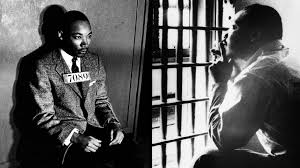
In a newspaper, smuggled into Dr. King’s jail cell, eight clergymen wrote a statement against his protests in Birmingham. King responded, writing in the newspaper margins, with his open letter. The result is one of the most important documents of the Civil Rights Movement.
In this letter, King defines and defends direct action. The most impactful lesson, for me, is how King ties broad philosophical themes together and places the social and economic justice movement as the next step of a global, biblical, historical, and uniquely American journey towards freedom. His philosophy of direct action is simple enough to allow people to participate immediately. His thoughts aren’t lost in the theoretical; they apply in the real world.
Dr. King promotes an assertive case for a movement too often seen as being only passivist in character. His movement was nonviolent and passivist, but it was not passive. It was active civil disobedience. Dr. King defends the urgency of his words, casting his crusade for justice as applicable for oppressors and oppressed alike. King’s belief is that direct action elicits a tension in the collective social mind and soul, and through this tension, justice wins in the long run. But, I don’t believe Dr. King sees his movement’s success as inevitable or guaranteed. Instead, he believes that the immediacy of civil disobedience can lead to this inevitability. In other words, Dr. King’s words stand on the pedestal of his long moral arc, but they are meant as a call to action in the here and in the now against injustice. I think that aspect of Dr. King’s legacy was lost on me until now.
LONG SUMMARY
I don’t know how long this summary will be. I have two goals: One, not to speak in hyperbole, though I will break this goal right now by saying this writing is one of the best I have ever read; Second: there’s so much to write about, my goal is for this summary not to be longer than the letter itself. Here it goes.
I listened to the audio reading of this letter three times, and I read through the text twice more. Here’s my main thesis: Dr. King’s definition of direct action is rooted in biblical, historical, global, and immediate callings, and by itself, inspires his professed cause for social and economic justice, but almost more importantly, his defense of direct action enables him to be an immediate, frequent, mobilized, and tangible actor in the movement. He is able to extend the civil rights movement in the philosophical realm as the inevitable American end goal of Jefferson’s inalienable rights in the Declaration of Independence. He is also able to act instead of just think, and is able to take his philosophy to address the here and now. In short, his defense of direct action works on two planes–on the long arc of his moral universe and on the short arc of sit-ins and protests in Birmingham.
On to details of the letter. One of King’s more interesting points comes at the conclusion of his writing. He says that he never would have wrote the letter from the comforts of his office desk: “what else is there to do when you are alone for days in the dull monotony of a narrow jail cell other than write long letters, think strange thoughts, and pray long prayers?” With this question, I think King is proposing a spiritual interpretation of “purpose” here. I am too humbled to put unintended interpretations into his readings, but for me, does the spiritual side of Dr. King intend to say that his imprisonment serves a greater purpose to bring his letter forth, or at least bring an inspiration to write the letter? In other words, is he simply making lemonade out of lemons, or did fate put him in that jail cell knowing that he would write that letter?
King believes that every nonviolent campaign has four steps: collection of the facts to determine if injustice is alive; negotiation to end the injustice; self-purification to ready to collective for the consequences of civil disobedience; and direct action–sit-ins, marches, peaceful protests, etc. In defending the morality and urgency of his direct action campaigns, King neutralizes the set forth criticisms that direct action causes too much social tension, is too disorderly, and is too untimely.
Regarding the criticisms of social tension and disorder, King makes a point, which is the most interesting to me: that just as tension of the mind triggers a quest for truth and knowledge, tension of the social mind initiates the search for social truth and social justice. King draws upon Socrates’ ancient philosophies, indicating that our academic freedom of thought today can be traced to Socrates’ sparking the tension of the mind. And then King extends that analogy to the movement, and in doing so, he implicitly reinforces his idea (present in many of his writings) that society is connected as one, and that we share one social mind, one social soul. Thus, according to King, this social tension is necessary to awaken the collective social mind and touch the collective social soul of those suffering the injustice and those enacting the injustice.
Regarding the criticisms of untimeliness, King invokes the underpinnings of his “fierce urgency of now” doctrine. He makes another favorite point of mine: there is nothing inherent about the passage of time itself that progresses towards justice. Time itself, according to King, is neutral. The catalyst events need to happen by those living in those quantized time moments to take it upon themselves to move towards justice–to bend King’s moral arc towards justice. King believes that once the social mind is awakened, and injustice is identified, then timeliness is not a question for nonviolent and peaceful campaigns to bend the arc. King goes into a discussion here about the tragedy of identifying an injustice and not acting with an urgency. He quotes “justice too long delayed is justice denied.” He also goes on a discussion that his mind can understand (but not accept) someone coming from pure ill will towards him, but he has a deeper struggle against “shallow understanding from people of good will.”
It is important though, for me to note this: I believe that King does not profess inevitability alone, he professes urgency to lead to inevitability. It is important for me to note this, because today, I went to the MLK memorial with my wife and daughter, and I mentioned to my wife that if people really listened to what Dr. King had to say, I’m not sure a monument would have been built for him. Not because it isn’t deserving or that his message of love and justice was not pure. They certainly are as relevant today as when they were written. His words alone embody the next evolution of the fundamental American Declaration. And that alone is worthy of a national monument. When Jess asked me to clarify, though, I realized that Dr. King’s words now are seen as an end, rather than a beginning. I am guilty of this, just as many others are. One can read those words, be inspired, be thankful that such a thinker lived and acted in our still young nation’s life. And at the end can believe that because we have dedicated a portion of our national consciousness to those words, that we some how have arrived at the mountaintop. What I am realizing through reading Dr. King’s writings is that his words were an attempt to identify a new perspective on extending God given rights of freedom and justice — and to raise a call that this identification is just the first steps in the march. And I don’t think we build monuments for movements that are still in the beginning.
King’s words were truly radical, mainly because they called for love and brotherhood in unexceptional terms. But they were radical too, because his practice of an American “Satyagraha” would have awoken a social consciousness. I think that scared a lot of people of power in his time, and I don’t know how people today would react either. I’m off on a wild tangent here, but maybe this is the seeds of the new legacy of race–the election of Obama, and then of Trump, the one step forwards, two step backwards feeling that Dr. King seems to have foreseen and accepted in this long march.
In his defense of direct action, King provides his definition of an “unjust law” and states that unjust laws must be disobeyed. He builds on a foundation set by St. Augustine and St. Thomas Aquinas. King defines four types of unjust laws: (1) Those that are against fundamental moral laws; (2) Those that are imposed on a minority but do not apply to a majority; (3) Those that are imposed without the consent of representation; and (4) Those where the letter of the law may be just, but its spirit is to deny rights and privileges of a certain group. Disobedience of unjust laws, according to King, is actually a high form of lawfulness. King does not advocate disregarding or evading unjust laws, but rather believes that civil disobedience requires the citizen to break the law “openly, lovingly, and with a willingness to accept the penalty.” King goes on to say: “I submit that an individual who breaks a law that conscience tells him is unjust, and who willingly accepts the penalty of imprisonment in order to arouse the conscience of the community over its injustice, is in reality expressing the highest respect for law.”
Lastly, before I get into the quotes that I liked, King’s genius in this letter comes from his ability to defend direct action in several ways: an implementation of a Biblical calling of love above all, light over darkness, forgiveness over hate; an extension of the American creed of freedom; a penance for our original sins of slavery and subjugation; a placement of the social and economic justice movement in a global context.
Now for the quotes:
“We must see the need of having nonviolent gadfiles to create the kind of tension in society that will help men to rise from the dark depths of prejudice and racism to the majestic heights of understanding and brotherhood.”
“There comes a time when the cup of endurance runs over and men are no longer willing to be plunged into an abyss of injustice.”
“Individuals may see the moral light and voluntarily give up their unjust posture. Groups are more immoral than individuals.”
“I have almost reached the regrettable conclusion that the Negro’s great stumbling block in the stride toward freedom is not the White Citizens Councillor or the Ku Klux Klanner but the white moderate who is more devoted to order than justice, who prefers a negative peace which is the absence of tension to a positive peace which is the presence of justice.”
“Shallow understanding from people of goodwill is more frustrating than absolute misunderstanding from people of ill will.”
“Lukewarm acceptance is much more bewildering than outright rejection”
“We will win our freedom because the sacred heritage of our nation and the eternal will of God are embodied in our demands.”
“Our destiny is tied up with the destiny of America.”
 Book Summaries. Less than 272 words.
3 thoughts on “Letter from Birmingham Jail, 1963, Dr. Martin Luther King Jr.”