RATING
2 stars
N/A = good but not on the scale
1 star = perspective supplementing
2 stars = perspective influencing
3 stars = perspective altering
SHORT SUMMARY (272 words or less)
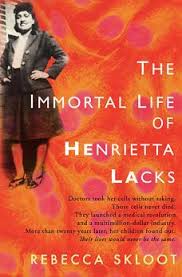
What a fantastic book. It toes the line between incredulity and fate, as Henrietta’s story seems both from another world and also destined to influence human progress.
Henrietta Lacks is the namesake of the”HeLa” cells prolific in medical research. HeLa cells derive from cervical cancer cells taken from Lacks in 1951. Incredibly, HeLa cells reproduced a new generation every 24 hours and were the first immortal human cell line to sustain generational growth in lab settings. And they are still growing today. HeLa cells have lead to breakthroughs in biomedical technology, advancing treatments for polio, HIV, HPV, leukemia, influenza, hemophilia, Parkinson’s, IVF, cancer, etc.
Henrietta was a young, black tobacco farmer in Baltimore who was treated for cancer at Johns Hopkins. She was treated as well as possible for the time, but her cells were taken without her or her family’s consent (not uncommon at the time). HeLa cells became, and still are, widely disseminated throughout labs around the world, and ultimately, biotech industries profited heavily from their distribution.
The author discusses race, economics and our institutions objectively in context of Henrietta’s story. In a heartbreaking quote, with a complicated question, posed by Henrietta’s son: “If our mother is so important to science, how come we can’t get health insurance?” It makes you really think about all sides of what that means.
But, here is the mind boggling theme. Cells from a woman who died tragically young from cancer continue to change the world 66+ years after her death. If there’s ever a cure for cancer, the fact that Henrietta lived on this earth will have a lot to do with it.
LONG SUMMARY
Started Feb. 16, 2017:
-At a high level, this book is about Henrietta Lacks, the forgotten donor and namesake for the HeLa cells that have revolutionized modern medicine.
-So, what are HeLa cells? Well, it’s a human cell culture that his been grown uninterrupted, since 1951. Before the HeLa cell culture, it was difficult for laboratories to sustain growth of human cell cultures, and thus, it was difficult for these labs to perform medical tests on drugs, therapies, and other medical modalities affecting human health. HeLa cells were taken from patient Henrietta Lacks of Baltimore at Johns Hopkins University. The cells are named “HeLa” due to the first two letters in Lacks’ first name combined with the first two letters of her last name.
Henrietta Lacks was diagnosed with an aggressive cervical cancer, and she died of the disease in 1951. Her cells, though, live on. During a surgical procedure performed while Henrietta was still alive, a sample of the cancerous cells was taken from her cervix and was grown in culture. The cells astonishingly sustained growth and continue to grow to this day.
Thus, Henrietta Lacks is said to be “immortal” because her cells can reproduce indefinitely in culture under the right survival conditions. In fact, more of her cells have grown after she died than ever did during her entire life. HeLa cells are profoundly important and have advanced medicine in so many ways. From the book, I’ve heard about their contributions to the Polio vaccine, genetic testing, AIDS research, cancer research, IVF, just to name a very few.
According to Wikipedia, to date about 20 tons of HeLa cells have been grown, and HeLa cells are present in almost 11,000 patients.
-The book is an interesting intersection between the medical benefits of Lacks’ cells and Lacks’ life and her family’s lives. The book weaves between these two narratives eloquently and in way that is educational and captivating. I’ll attempt to capture the points that stand out, but even without factual tidbits to take away, this book is worth the read.
-Interesting fact: after Henrietta Lacks died, the HeLa cells were sent to the Tuskegee Institute for growth and reproduction. The historical irony here is especially strong. At the same time when the cells belonging to Henrietta Lacks, an African American woman from Baltimore, were being massively reproduced, the Tuskegee Institute was performing its infamous experiments where doctors unethically “treated” 600 men for syphilis. These men were not told that they were not being treated for syphilis (and instead being treated for something else) or that they were being treated using ineffective means (after penicillin was known to be a cure for the particular disease).
-The experiments by Chester Southam. This is actually kind of a crazy, fucked up side story. This Dr. Southam at Sloan Kettering wanted to know whether researches who were handling HeLa cells were susceptible to contracting an infection or cancer. So this guy proceeds to inject several sick women with HeLa cells, without their consent, to see if cancer would grow. In some women it did grow and at least with one woman, it metastasized. He then wanted to inject healthy people with HeLa cells, so we went to the Ohio prison system and got healthy men to volunteer for the injections. When he found that many of the healthy men’s immune fought off the HeLa cells, he then proceeded to expand his experimentation on other health populations outside of prison, back at Sloan Kettering and then later at Jewish Chronic Disease Hospital. At this hospital, a few of Southam’s colleagues blew the whistle, mainly because they remembered the implications at Nuremberg (these experiments were conducted in the mid 50s and 60s). During the Nuremberg trials, several Nazi doctors were sentenced for hanging for their grotesque experiments during the Holocaust. From these trials, the notion of “informed consent” became a benchmark for medical practice, something that the Hippocratic oath did not speak to. Soonafter, the whistle blowing, Southam was investigated by the Board of Regents at the University of the State of New York and he was found guilty of unprofessionalism and deceit. His license was suspended for one year. But here’s the crazy part–he was later renamed president of the American Cancer Society.
-HeLa cells were sent to space by the Soviets in 1960 n Sputnik 2. It was discovered that HeLa cells actually grow more aggressively in space than on Earth.
-The “HeLa bomb”– during a conference in 1966, a scientist announced that all of his human cell cultures, which he thought was free of HeLa cells, was actually contaminated by HeLa. The scientist discovered this because all of his human cells had a genetic marker, G6PD-A, which was indicative of African American cellular origin. HeLa cells would grow aggressively in culture and take over all other cells. I’m not exactly sure how it works, but I think it had something to do with HeLa cells starting the cell culture and then the idea was that other human cells would grow in the culture, with HeLa being removed. This discovery was known as the HeLa bomb because in labs across the world, when scientists thought that they were growing human cell cultures free from HeLa, many of the cell cultures were actually taken over by HeLa. This was detectable by testing for the G6PS-A marker.
-Spontaneous transformation refuted. Because HeLa cells had been discovered to have taken over a lot of human cell cultures, the theory of spontaneous transformation in cancer growth was disproved. Basically they theory was that in human cell culutres that were thought to be free of HeLa, normal cells would spontaneously transform to be cancerous. The idea was that if scientists could identify the moment of transformation, they could determine the mechanism to attack cancer. However, the HeLa bomb disproved this and showed that the cells that underwent what was thought to be “spontaneous transformation” were actually HeLa cells taking over.
-The book does a really great job weaving the narratives of the Henrietta Lacks’ family together where her larger medical story and the story of HeLa cells. I really enjoy this about the book. That it does not water down the complex relationship between race and economics against power institutions. One interesting point of discussion is author’s explanation of a long and troubled history between certain minority communities and prominent hospitals, including the mistrust between African Americans in Baltimore and Johns Hopkins University. The author gets into details of the history of medical institutions and how the treatment of blacks, both very real and also imagined, fed into this deep mistrust. A particular telling example of this is the anger that the Lacks’ family had (has?) towards Henrietta’s cells being used for scientific research (and profit) without what they believe to have been proper consent.
-In one very telling quote: “If our mother is so important to science, how come we can’t get health insurance?”
-The author goes into the interesting legal landscape regarding ownership of cell lines. HeLa cells were not the only cells to be contested regarding ownership. The “Mo cell line” named after John Moore was the subject of an important legal debate. Moore had gone to UCLA for treatment of a rare form of leukemia. In a riveting series of events, eventually Moore discovered that his doctor at UCLA was growing and maintaining his cell line due to its very valuable traits. In particular, the Mo cell line grew particular proteins that stimulated the growth of white blood cells. The doctor at UCLA profited from this cell line, contracting with a biotech company for millions of dollars for access. Moore sued the UCLA doctor on the grounds that the commercial value of his cell lines were withheld from him, and thus we did not (and was not able to) give informed consent. He lost the initial court battle, but later won the appeal where a California court ruled that he had rights to profits derived his cell line, even in spite of the Mo patent. Ultimately, though, the California Supreme Court held that the Moore had no rights to profits derived from his discarded cells. The court did hold that the doctor breached his fiduciary duty to reveal his financial gains and potentials from the Mo line.
-Back in Baltimore, the Lacks’ family was not following the Mo line case, but they were lobbying for JHU to give them what they believed was their fair share of profits. The argument is an interesting one: on one had, setting up a legal regime to prevent growth of cell lines may impede scientific progress, but on the other hand, the ownership battles that biotech and pharma companies already engage in impede this progress. So you can’t solely use the argument for scientific advancement to justify the social, legal and moral cost of not addressing the issue of proper ownership of your own cells. Moreover, Henrietta Lacks’ was in a unique situation compared to the Mo line. In the Mo line case, Moore was still alive and thus as a living patient was able to at least legally challenge the proprietary and profitable nature of his cellular line. Henrietta Lacks had died while her cells proliferated. What type of legal avenues are available for this scenario?
-Interesting discussion about HeLa cells and how some scientists have tried to classify them as an entirely new non-human species due to their immortality and growth properties.
-HeLa cells were used to develop the HPV vaccine and also used for significant AIDS research. I’ll probably look this up, but I wonder how many Nobel Prizes were based on work done using HeLa cells at the very least.
-Hayflick Limit: The number of times that a cell can divide before division reaches its limit. This has to do with telomeres which are strings of DNA at the end of chromosones that dictate how many more times a cell can divide. As cells go through their normal lives, their telomeres shorten which each division until they die. The length of telomeres correlates with a person’s age, as the older they get, the less number of rounds of divisions their cells have. Cancer cells have an enzyme called telomerase, which rebuilds the cells telomeres.
-It must have been maddening to be in the Lacks’ family’s position once they started finding out how famous and important Henrietta’s cell became. The continuous refrain seemed to be that HeLa cells advanced medical science so significantly and literally formed industries in biotech, but their family did not see a penny of that. It’s a tough argument–monetary and scientific benefits from HeLa were diffused and there wasn’t a pile of cash just sitting somewhere, but still, there is a base level of empathy you can have there.
-The legacy of HeLa cells is remarkable–they have lead to treatments (and cures in some cases) for polio, HIV treatments, HPV, leukemia, influenza, hemophilia, Parkinson’s, IVF, cancer, STDs, appendicitis, etc. An apt quote from the book–if there is ever a cure for cancer, it will be in large part due to Henrietta Lacks. HeLa cells also lead to discussions and ultimate reforms in medical ethics and procedures and practices around patient consent.
 Book Summaries. Less than 272 words.
One thought on “The Immortal Life of Henrietta Lacks, by Rebecca Skloot”